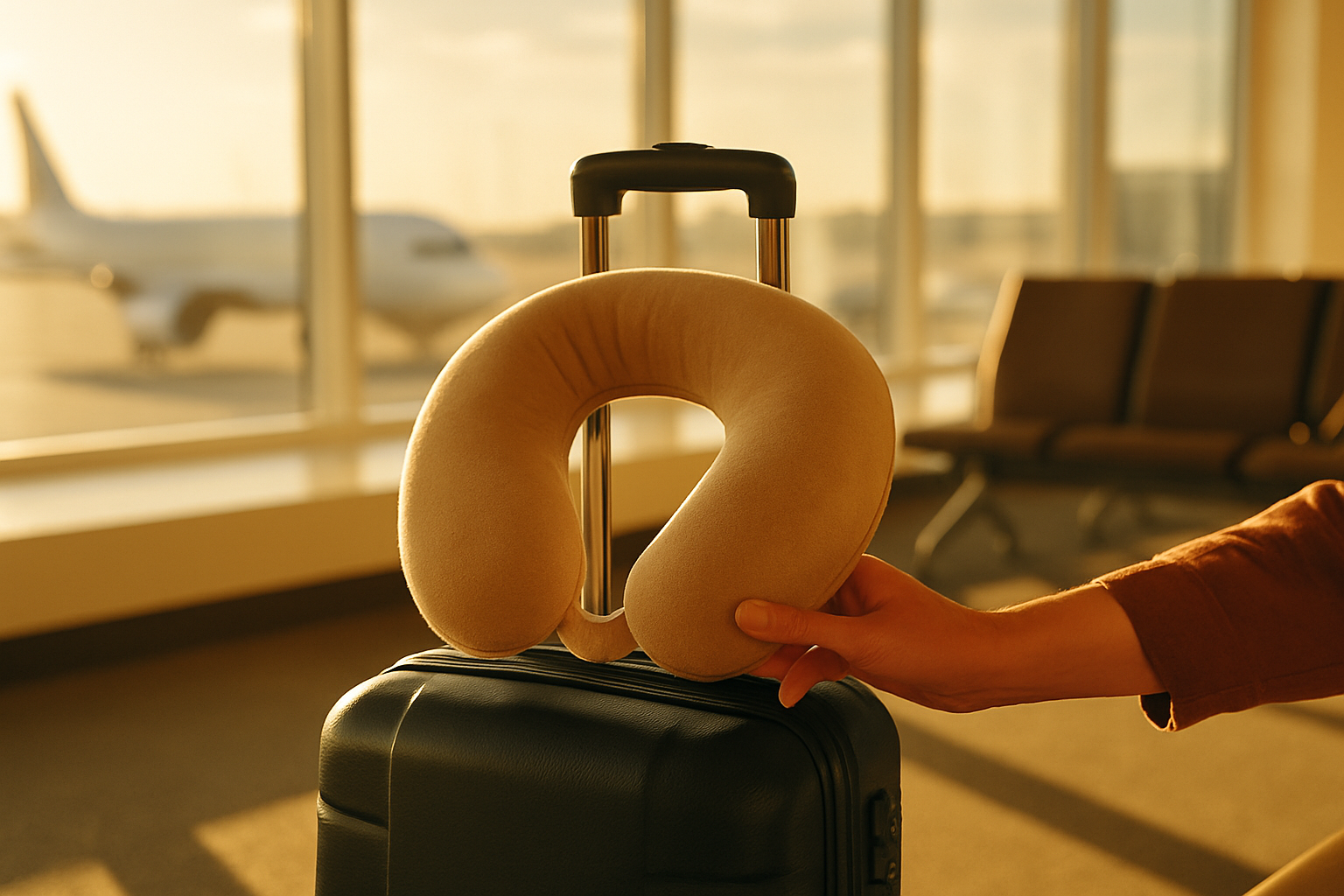
The short answer: yes, for many solo economy passengers who sleep upright, the Cabeau Evolution S3 often feels like a real step up from the basic U-shaped pillows sold at kiosks. It gives firmer lateral and forward support than a floppy cushion, stays put once adjusted and, with a washable cover, solves the hygiene problem most travellers worry about.
How this review approaches value
Value for a solo traveller arriving stiff and exhausted depends on three things: how you sleep on planes, how much carry-on space you can spare, and whether you actually need hold-your-head-in-place support rather than a soft cushion. This review treats the Evolution S3 as one option in a practical toolbox. It asks: does it prevent the head-drop that ruins sleep, can you live with the bulk, will you keep it clean, and is it worth the outlay if you fly economy overnight two or three times a year?
What the Evolution S3 does for neck support
Most stiffness after a flight comes from the head falling forward or to one side and the neck muscles fighting to stop it. The Evolution S3 is designed to stop that head motion. Rather than a thin pillow that lets your chin fall, it offers firmer foam and a shaped collar that cups the jaw and sides of the head.
That shaped support changes how your neck muscles have to work. If you normally wake with your head awkwardly angled, the extra front and side resistance reduces microadjustments and the surprise head-drop that wakes you. If you sleep sprawled and change positions frequently, a fixed collar can feel restrictive; some people swap to a softer inflatable for that reason.
Comfort over multiple nights and long-haul itineraries
Comfort is two things: initial feel and staying comfortable over successive nights of travel. For single overnight flights the Evolution S3 gives a steady, predictable experience: the foam does not deflate or unravel, and the shape remains consistent. That predictability matters. Knowing that a pillow will not suddenly collapse is what lets you doze on a connection without panic.
On consecutive nights, memory foam can be both a blessing and a nuisance. It moulds to your neck but also traps heat. If you are travelling in a warm cabin, the pillow can feel warmer than a scarf or inflatable ring. A breathable cover helps, but if you are sensitive to warmth you should pair the pillow with an eye mask and thin cooling neck gaiter, or choose a pillow with a more open-cell foam.
Two practical points: first, if you have pre-existing neck pain consult a physiotherapist before relying on a travel pillow as treatment. Second, use the pillow during a short sleep trial at home before a long trip. That way you can check whether the jaw and cheek support is comfortable for your sleeping style.
Compressibility and what you carry on
Memory-foam travel pillows are bulky compared with inflatable models. You should expect the Evolution S3 to take dedicated space in your carry-on or attach to your bag. If you travel light, that matters.
Think in terms of three packing profiles:
- Minimalist: you want everything in a single small backpack. An inflated pillow wins here because it packs down tiny.
- Balanced: you have a carry-on and a personal item. A foam pillow is reasonable; you can clip it to a suitcase handle or tuck it into an outer pocket.
- Comfort-first: you prioritise sleep on the plane and accept the extra bulk. Foam is the better choice for support and consistent feel.
Practical tip: if you plan to carry the pillow by its clip on the outside of a luggage trolley, test it before you travel. Some bag straps and cabin boarding lanes make an external pillow awkward and it can be put in overhead space only to get flattened by other items.
Hygiene: how easy is it to keep clean
Hygiene is a reasonable concern. The appeal of a washable cover cannot be overstated. A zip-off cover that you can machine wash between trips dramatically reduces the maintenance headache. If you pick up a scent or light staining, a removable cover lets you freshen the pillow without waiting days for foam to dry after a full wash, which can be slow and awkward.
Even with a removable cover, plan for day-to-day upkeep. Air the pillow in a ventilated space for a few hours after each long flight. If you are travelling back-to-back, carry a thin travel pillowcase or a large scarf you can put over the cover. That gives a quick, disposable layer you can change at the hotel or in a hostel room.
How it performs in real-world seat types
Economy seats vary. The same pillow behaves differently in a modern slimline seat with a firm headrest and in an older, deep-contour seat.
In seats with small headrests the Evolution S3's collar is doing most of the work and you will usually get good lateral and forward support. In seats whose headrest already curves well, the pillow primarily stabilises the lower neck where the seat leaves a gap. The pillow is most noticeable when the headrest is flat or when you want to sleep leaning to the window.
Worked example: say you are flying London to Singapore on a 13-hour economy fare with two nights of travel involved and scarce checked baggage. You sit in a middle seat with a small headrest and little shoulder room. A shaped memory-foam collar will prevent your head from falling toward the aisle and will keep your chin from collapsing toward your chest, which reduces neck strain on arrival. You will need to carry the pillow on or clip it to your bag for the flight. If you try to reuse an inflatable pillow between sectors, you may find it less supportive at night and wake stiff.
What goes wrong and how to handle it
Nothing is perfect. Here are the common problems and what to do when they happen.
- Too warm: remove the cover for a while and breathe on the foam; change into a lighter scarf to reduce contact area. Consider buying a thin cotton sleeve for long stints.
- Restrictive feeling: loosen any central strap, or rotate the pillow so the collar supports the lower neck only. If that still feels bad, you will need a pillow that allows freer head motion or an inflatable model.
- Bulk is a burden at the gate: keep a compact inflatable in your packing list as a backup. If your main pillow goes missing because a bag is delayed, an inflatable wins as a rapid replacement.
- Pillow forgotten at seat or on the plane: make a note on the day of travel to check your seat pockets and armrest area. If you return to the gate, airport lost property often holds items for a short time. If it is lost for good, adapt fast: roll a scarf, use two sweaters, and use your coat collar for temporary chin support.
Deciding whether the Evolution S3 is worth it for you
Answer three quick questions:
- Do you sleep upright and want strong lateral and forward support?
- Do you mind carrying a modestly bulky item in your carry-on or clipped to your bag?
- Do you prefer a pillow that keeps its shape night after night without reinflation?
If you answered yes to all three, a shaped memory-foam pillow such as the Evolution S3 is likely worth the purchase. If you sleep on your back and rarely nod off upright, or if every inch of carry-on space is precious, an inflatable pillow could be a smarter choice.
Also consider price relative to frequency of use. If you fly overnight once a year, a cheap inflatable plus a good eye mask and soft headphones will give most of the restorative benefit. If you fly economy overnight several times a year, a higher-quality foam pillow is an investment in sleep quality that compounds quickly.
How to use the pillow so it actually helps
Buying a pillow is not enough; you must use it well. Here is a short sequence to convert a pillow into usable sleep on an economy flight.
- Before you fly, run a trial at home on a chair. Adjust the strap so the collar supports but does not force your chin up.
- At boarding, clip the pillow to your carry-on to avoid misplacing it under the seat, or keep it in the plane-side pocket if you prefer immediate access.
- When seated, recline the seat a little. Use the pillow to stabilise the lower neck, not to prop your head forward.
- Combine the pillow with eye mask and earplugs or noise-cancelling headphones. Movement and noise are the real obstacles to long stretches of sleep.
- Wake every 60 to 90 minutes to stretch the neck and shoulders. A pillow that keeps your head rigid for hours can make the muscles sore if you never move.
Alternatives and when they make sense
Alternatives are not failures; they suit different priorities. Inflatable pillows pack tiny and let you customise firmness, but they can feel unstable and often lack lateral chin support. Roll-style pillows and neck scarves are compact and cheap; they work well if you turn and change position. Full travel neck braces are medical devices and should be used only if prescribed.
Choose an alternative when the single deciding factor is space, when you change sleeping position a lot, or when you are very temperature sensitive. Choose shaped foam when the problem you are trying to solve is a head-drop that leaves you stiff on arrival.
Care and maintenance checklist
- Confirm whether the cover is machine washable and follow the manufacturer washing instructions before you travel.
- Air the foam between uses for at least a few hours in a ventilated space to reduce trapped odours.
- Carry a spare thin travel pillowcase or large scarf to place over the cover on long trips.
- If you need to wash the foam, allow it to dry completely; foam retains moisture and can mildew if packed damp.
- Inspect the clip or fastening that attaches the pillow to luggage; connectors can break and leave the pillow dangling.
Where travel insurance fits into this decision
Travel insurance is not directly about pillows, but if you count on a pillow to protect a pre-existing neck condition make sure your health cover is appropriate. If a single disrupted itinerary forces you to sleep overnight in an airport or on a short-notice hotel bed, the combination of insurance and reasonable gear can limit the damage. If you want guidance on cover that fits active travel and health needs, see an appropriate anchor phrase.
Frequently asked questions
Will a memory-foam travel pillow stop all neck pain?
No. A travel pillow reduces the specific strain of head-drop when you sleep upright, but it will not cure underlying cervical issues. If you have chronic neck pain, get professional advice before buying a pillow to manage symptoms on flights.
Can I put the pillow in checked luggage to save space in the cabin?
You can, but you lose the pillow for the flight and risk it being compressed or misplaced. If you value the pillow for sleep on the plane, keep it in carry-on or clipped to your bag.
How do I know if the pillow will fit my neck size?
Manufacturers publish dimensions. Compare those measurements with a tape measure at home, or try a similar shaped pillow in a shop. A short trial on an upright chair gives a reliable indication of fit.
Are there flight situations where a foam pillow makes things worse?
Yes. If you need full head freedom to move or if cabin temperature runs hot, foam can feel restrictive and warm. On short daytime hops or when you change sleeping positions often, a softer or inflatable option can be more comfortable.
What should I do if the pillow smells or stains during travel?
Remove and wash the cover if it is machine-washable. Air the foam for several hours in sunlight where possible. For small stains on the cover, spot-clean and launder; for persistent odours, a full cover wash followed by airing usually removes them.