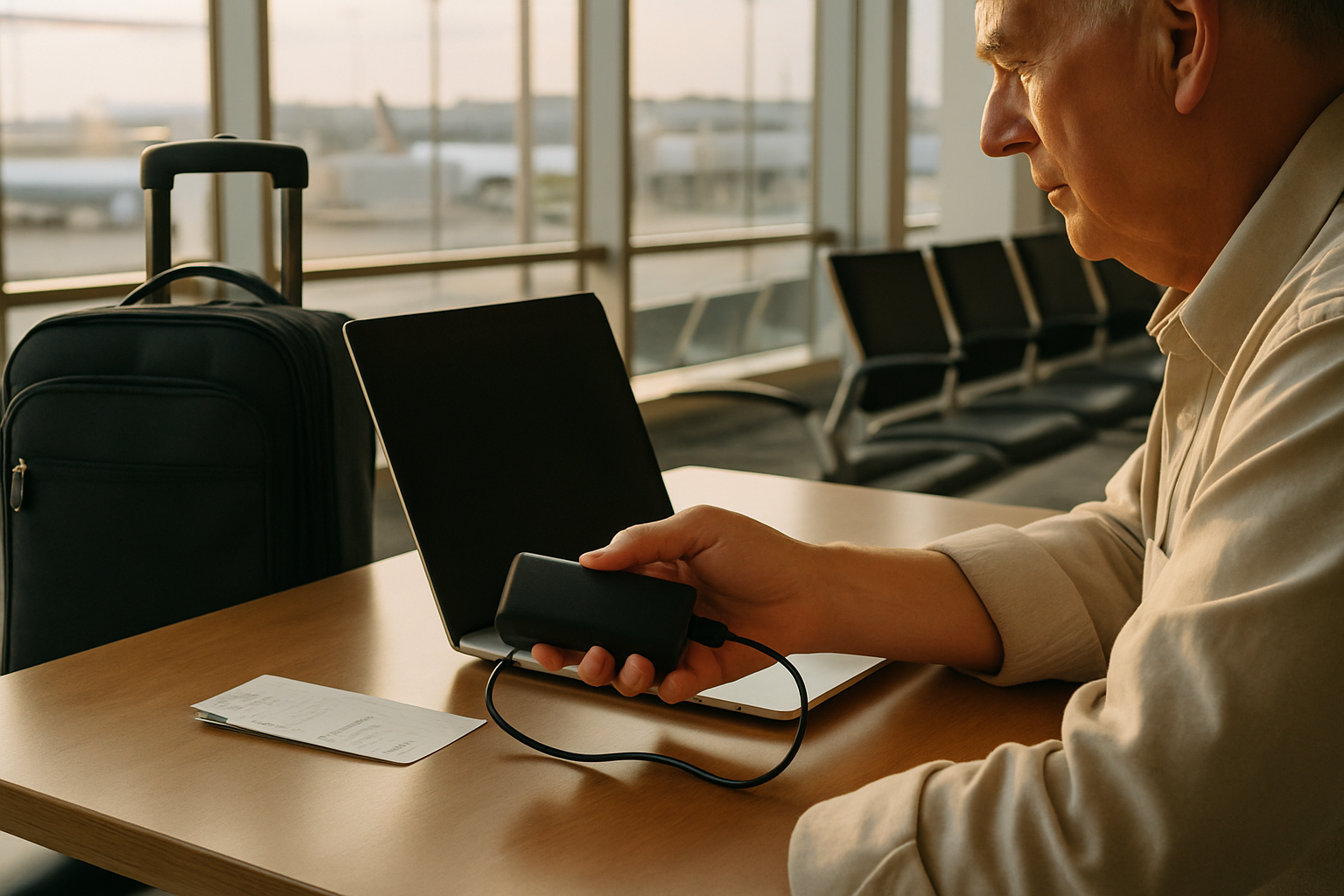
Short answer: neither model is automatically allowed or banned because what matters is the battery's watt-hours and the airline's policy. Check the marked Wh rating, keep the bank in your hand luggage, and ask the airline for approval if the rating is between 100 and 160 Wh. For everyday frequent flyers the safest choice is a bank with a labelled Wh of 100 or less; if you need a higher-capacity unit for laptops, prepare documentation and permission before you fly.
How airlines actually treat power banks
Airlines and regulators classify portable chargers as lithium ion batteries. The rule most carriers follow is simple in structure: batteries must travel in the cabin; small batteries are fine; mid-size batteries need approval; large batteries are not permitted. That structure is consistent across regulators, but the implementation varies by airline and region.
What changes from carrier to carrier is the threshold for requiring approval, how they want you to show the battery's rating, and whether they let you use a bank in flight. Many will accept any bank clearly labelled with a watt-hour value, while some require a manufacturer specification sheet or a sticker on the product. A few airlines are stricter in practice and will refuse anything over 100 Wh without formal pre-flight approval.
Always check the airline's official website under "dangerous goods" or "batteries". If you cannot find a clear policy, call or email customer support and keep a screenshot or the reply. Approvals are easier to obtain when you can quote the exact Wh rating and the model number.
Wh versus mAh: how to check the number that matters
Manufacturers commonly list capacity in milliamp hours (mAh) because it looks impressive. Regulators use watt-hours (Wh). If the product carries a Wh label, use that. If not, you can convert mAh to Wh using the nominal cell voltage. The standard conversion is:
- Wh = (mAh / 1000) x nominal voltage
Most power banks use cells rated at 3.7 volts nominal. That means a 20,000 mAh bank is roughly (20,000 / 1000) x 3.7 = 74 Wh. Use the label on the bank or the manual first; only convert when you must.
Worked example: say the unit label shows 26,800 mAh but no Wh. Convert using 3.7 V: 26.8 x 3.7 = 99.16 Wh. That lands under the common 100 Wh threshold and usually means you can carry the bank without prior approval. If the converted number sits above 100 Wh but below 160 Wh, you will likely need written airline approval before travel.
Where the two models differ in practice
Both the Anker 737 and the Zendure SuperTank Pro are aimed at travellers who need laptop-level charging away from the mains. For a frequent flyer the relevant differences are not brand prestige but three operational points: the labelled Wh, the bank's maximum USB-C power delivery (how fast it will charge a laptop), and whether it supports pass-through charging (charging the bank while it charges your devices).
Labelled Wh answers the carry-on question. USB-C power delivery answers whether the bank will actually run your laptop at a useful speed. Pass-through answers whether you can keep the bank connected to the plane's USB power or a wall socket while still charging devices. All three appear on product pages or on the specification sticker; if you cannot find them there, the seller should be able to provide a specification sheet or user manual.
Pass-through charging: useful, but potentially problematic on a flight
Pass-through charging lets a power bank charge from mains power while simultaneously supplying power to a device. For example, you could plug the bank into a wall outlet at a hotel and keep a phone drawing from it. That sounds convenient, but manufacturers and some aviation authorities discourage using pass-through with lithium batteries because it can stress the cells and increase heat.
On a plane the risk is practical: the cabin crew may ask you to disconnect a device if the bank is running hot, and some airlines forbid pass-through in flight. If you rely on pass-through to extend your laptop time on long sectors, you will want to verify two things before travel: that the bank supports pass-through on the port you intend to use, and that your airline allows it in flight.
If the feature matters to you, look for explicit manufacturer language: not just "simultaneous charging" but the conditions under which it works (which ports, whether there is reduced output, and whether the bank can be charged from a power source that supplies less than its maximum rated input). If the documentation is vague, treat pass-through as a convenience you might not be allowed to use in the air.
USB-C power delivery and real laptop charging
USB-C Power Delivery, or PD, is the protocol that negotiates voltage and current between a charger and a device. For a modern laptop you care about two numbers: the maximum PD output the bank can sustain, and how long the bank will provide that output before it is depleted.
Max PD output determines whether the bank will merely top up your laptop or run it under full load. A bank rated for 45 W PD will charge a small ultrabook well but will only maintain a heavier laptop under light load. A bank rated for 65 W to 100 W will handle most mainstream laptops at normal use. The sustained output matters more than the peak rating: some banks advertise a 100 W peak but only sustain 60 W for long periods.
For frequent flyers this is the practical test: if you need to work on a long-haul flight and expect to run a laptop for hours, choose a bank whose sustained PD matches the laptop's power draw. Check your laptop's typical draw (you can approximate this from the laptop charger rating, which is a maximum, not normal draw). If you don't want to calculate, plan for a bank that matches the charger rating of your laptop rather than a lower number.
Size, weight and gate/headache trade-offs
High-capacity banks are inherently heavier and bulkier. That matters because frequent flyers prize carry-on efficiency and want to minimise friction at security. A slightly smaller bank with a clean Wh label and a single high-power USB-C port will cause fewer questions than a hulking unit with multiport outputs and a missing Wh figure.
There is also a practical carry issue: pockets and top pockets on cabin bags are limited. If you place a heavy bank in an outer pocket and gate-check luggage or hand it to a flight attendant for stowing, it becomes inaccessible. Keep high-capacity banks in an inner compartment you can open quickly at the security checkpoint and at the gate.
What happens at security or the gate and how to respond
If security or a crew member asks to see your power bank, be ready to show the Wh rating or the spec sheet. If the bank is under the airline threshold you will usually be allowed to proceed. If it is between 100 and 160 Wh and you do not have prior approval, you face two outcomes: the agent may refuse boarding, or they may detain the bank for inspection and either allow it or confiscate it.
Never put a power bank in checked baggage. If an agent tells you to check it, explain calmly that regulations do not permit it and ask for a supervisor. In many cases a supervisor will accept the bank in the cabin or give you the option to remove it from the flight. If you must surrender the unit, get a written record of the confiscation if possible.
Checklist to prepare before you travel:
- Locate the labelled Wh on the unit or in the manual. If no Wh is shown, convert mAh to Wh using 3.7 V and round up slightly for safety.
- Check your airline's battery policy online and save a screenshot or an email confirmation.
- If the bank is 100 to 160 Wh, request written pre-flight approval from the airline and carry their response.
- Pack the bank in your hand luggage and keep it accessible for inspection.
- Know whether the bank supports pass-through and whether you plan to use that feature in flight; if you do, check the airline's position on in-flight charging.
What to do if your flight is cancelled or you must store the bank temporarily
Delays and cancellations are the most common situations where you might be asked to stow or remove a power bank. If you are going to leave the airport and return later, take the bank with you. Airports and airline lounges will not accept batteries for storage on your behalf unless explicitly stated.
If you are diverted or the airline needs to transfer you to a different aircraft, keep the bank on your person. Cabin crew may ask you to ensure the bank is switched off. If they insist on stowing it, make clear you will keep it in your carry-on and ask for written instructions from the crew. If the airline demands surrender for safety reasons, request a receipt.
How to choose between the two models as a frequent flyer
Decision criteria are specific to you. Use these questions in order; they cut through marketing and get to the only relevant facts.
- What Wh does the unit show? If 100 Wh or under, the unit is the least troublesome option for frequent flights.
- Do you need to run a laptop at full speed? If yes, pick the unit with higher sustained PD output rather than the one with the largest mAh number.
- Do you rely on pass-through in airports and lounges? If so, choose the unit whose documentation explicitly supports safe simultaneous charging and discharging on the ports you use.
- How important is weight and carry convenience? If you travel light, a slightly lower capacity but lighter bank will reduce gate friction and save space on crowded flights.
If the choice is between two banks you already own or have confirmed specs for, here is how to decide quickly: if one is under 100 Wh, use that for all flights where you want zero hassle. Reserve the higher-Wh unit for trips where you can secure pre-flight approval or where you will travel with it in hand luggage and accept the possibility of extra scrutiny.
Worked example you can map to your own situation
Say you fly weekly on short European sectors and occasionally on intercontinental overnight flights. You have two banks: one shows 74 Wh and the other shows 120 Wh. You also carry a 65 W laptop.
For short sectors and gate-hopped trips, use the 74 Wh bank: no approval needed and security checks are straightforward. For the overnight long-haul where you need to run the laptop for a few hours, use the 120 Wh bank only if you have prior airline approval. To get approval, email the airline at least 48 hours before departure with a photo of the unit's label, the model number and the Wh rating. Save the airline reply on your phone and show it at check-in and security.
At the gate, put the 120 Wh bank in your carry-on in a pocket you can open without taking off your coat. If a crew member asks you to power it down, do so and explain you have airline approval. If they still refuse to allow it, accept their instruction and use the 74 Wh bank instead; escalate later with the airline for a clarification if this becomes a recurring issue.
What goes wrong and how to handle it
Common problems are straightforward and solvable: a missing Wh label, a surprised gate agent, or a bank that overheats. For a missing Wh label, find the model number and the manufacturer's specification sheet online and present that. If the agent still refuses, ask politely to speak to a supervisor. For an overheated bank, immediately disconnect it, place it on a non-flammable surface, and notify crew or security; do not put it in checked baggage or a bin with luggage.
If an airline confiscates a bank, ask for a written confiscation note and request an explanation in writing. If the bank was expensive and you have travel insurance that covers loss or confiscation, you can follow the insurer's claims process. For help understanding what your insurance will (or will not) cover, consult your policy wording under personal effects or lost property, or visit an appropriate anchor phrase for a guide to travel insurance basics.
Final practical notes
Buy a bank with clearly printed Wh if you travel often. Keep the original packaging or a printed specification sheet in a small travel document folder. If you carry more than one bank, label them clearly and ensure you can show combined documentation easily; while airlines check individual battery ratings more than totals, having clear documentation speeds inspections.
One last tip: battery technology and airline guidance change. Make a habit of checking airline policy and the manufacturer's website before any flight where you plan to use a high-capacity unit. That small bit of preparation removes most of the friction you will otherwise encounter.
Frequently asked questions
Can I put a power bank in checked luggage?
No. Lithium ion power banks must be carried in the cabin. Airlines and safety regulators prohibit them in checked luggage because of fire risk. If told to check a power bank, request a supervisor and explain the safety rule, but be prepared to comply with gate staff instructions.
Do I need airline approval for a bank that says 120 Wh?
Yes. A battery between 100 and 160 Wh generally requires airline approval before carriage. The process is simple: provide the model number and the labelled Wh to the airline and keep their written response. Without approval you risk denial of boarding or confiscation at the gate.
Is pass-through charging allowed on planes?
Some airlines permit in-flight charging but many restrict pass-through because it can generate heat. Even if the bank supports pass-through on paper, check the airline's in-flight rules and be prepared to disconnect if crew or security ask you to do so.
What should I do if a security agent wants to test the power bank?
Cooperate. Security may ask you to power it on to show it is a working device and not a disguised item. If you cannot power it on, provide the manual or the online spec sheet. If the agent persists in refusing carriage, ask for a supervisor and keep a record of the interaction.
How often should I replace a power bank used for travel?
Replace a bank if it shows signs of swelling, repeated overheating, significant capacity loss, or if the manufacturer issues a recall. Regular weekly use on long trips shortens lifespan, so monitor capacity and physical condition and retire any unit that becomes warm under normal loads.